Kovant OS is a neurosymbolic system. The context layer runs across it, the reasoning core decides what should happen next, and the policy core decides what is allowed to reach your systems. It is built as five layers, from your cloud upward.
Layer 01 · Your cloud and your data
Everything runs inside your own cloud tenant.
Kovant deploys into your own cloud tenant and reads your systems in place. Your data is not copied out of your environment, and it is never used to train models. Your security team keeps the perimeter it already operates, your data residency remains where you chose it, and the audit record is stored inside your environment alongside everything else. Every layer above inherits this boundary.
Layer 02 · Integration Hub
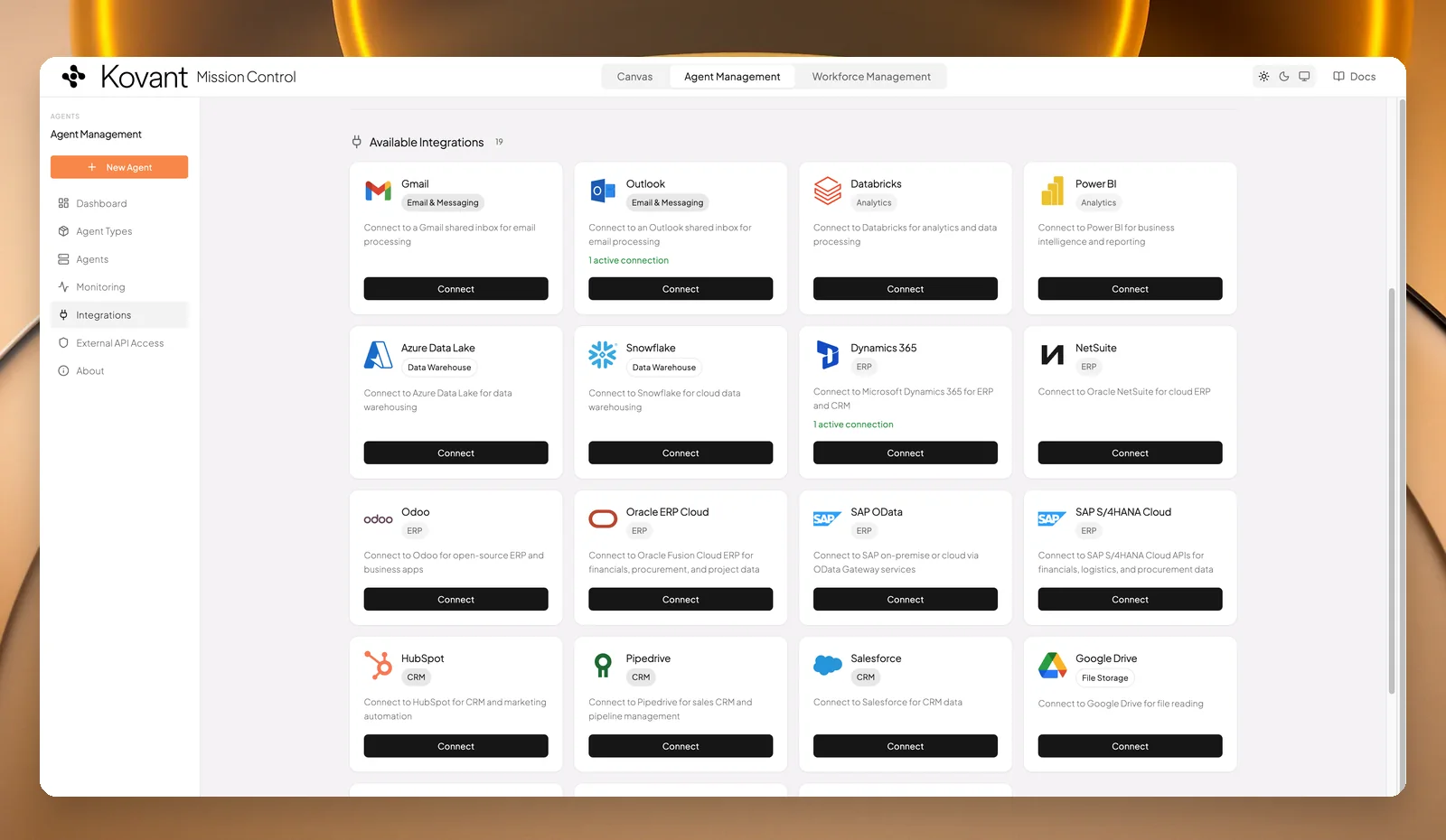
Kovant connects to your existing systems.
Kovant reaches your ERP, your data platforms, your collaboration tools and external data sources through one governed connection. It reads and writes in place, in the systems your teams already use, so nothing is replaced and there is no second copy of your data. New systems join through the same connection and under the same rules.
Layer 03 · Agentic Core
The operating system runs the work.
The Agentic Core holds the context the work runs on, the agents that do the work, the neurosymbolic core that governs them, and the runtime that executes approved actions. An action travels down through this layer. Kovant assembles the context, an agent decides what should happen next, the core validates the decision against your rules, the runtime dispatches it into your systems, and every step is recorded in real time.
Agentic Core · Context layer
Kovant holds the context the work runs on.
The context layer cuts across the Agentic Core rather than sitting inside any one agent. Kovant assembles what a decision needs from your systems, from the record of what has already happened and from the operations that ran before it, then distributes that context to the seat doing the work. Because it is held once and shared, every seat reads the same picture, and what one operation establishes is available to the next.
Agentic Core · Foundation agents
Each agent holds a book of work.
An agent owns a lane and carries the work in it from end to end, rather than waiting to be given a task. It reads what arrives in your systems and your inboxes, decides what should happen next and proposes the action together with the context that led to it. Agents work in Concierge, where your team can see them, question them and direct them, and they escalate only what needs a person.
Agentic Core · Reasoning core
The reasoning core decides instead of following a script.
The reasoning core reads the situation, weighs it against your operational context and history, and chooses the action instead of executing a predefined path. This is what allows the system to absorb the variation that no workflow could script, such as a late confirmation, a partial delivery or an order that does not fit the standard case.
Agentic Core · Policy core
The agent cannot talk its way past your rules.
Every proposed action is validated against your rules deterministically before it reaches your systems. An action that passes goes straight to your systems. An action that does not pass is escalated to a named owner with the reasoning attached, and nothing happens without that person's decision. Spending limits, approval thresholds and segregation of duties are enforced structurally rather than suggested in a prompt.
Agentic Core · Runtime
The runtime executes only approved actions.
Execution and monitoring run in a model-agnostic environment inside your tenant. The runtime dispatches approved actions into your ERP and the systems around it, confirms their completion and reports the changes. Because it is model-agnostic, the system scales from a single seat to a full operation regardless of changes in the underlying models.
Agentic Core · Record and audit
Every action enters the record.
Every action, dispatched or escalated, is captured with its inputs, its reasoning and the resulting record. The record runs alongside the agents, the core and the runtime rather than beneath them, so it is complete by construction. An audit becomes a query rather than a project, and any wrong decision is traceable and reversible.
Layer 04 · Kovant DSL
Your operation is defined once, as code.
The Kovant DSL expresses how an operation runs and which rules govern it, including the book of work each seat holds, the thresholds, the approval routes and the segregation of duties. It is versioned, reviewed and tested like code, so every rule change is visible, approved and reversible. Because there is a single copy of the rules, an auditor reads the same rules that govern the system.
Layer 05 · Kovant OS
Your team meets the work here.
Concierge is the application where your team works alongside the agents. There they can ask what is happening, approve what requires approval and handle every escalation in one place. Mission Control is where they govern the operation. It shows what every seat did, what it escalated and what changed, lane by lane, so the people accountable for the operation can watch it run and set its authority.

 SAP
SAP Dynamics 365
 Oracle ERP Cloud
 NetSuite
 Odoo
Odoo Salesforce
 HubSpot
 Pipedrive
 Databricks
 Snowflake
 Azure Data Lake
 Power BI
 Outlook
 Gmail
Gmail Microsoft Teams
 SharePoint
 Google Drive
 Google Search
 Bing Search