The uncomfortable truth of Procurement Automation

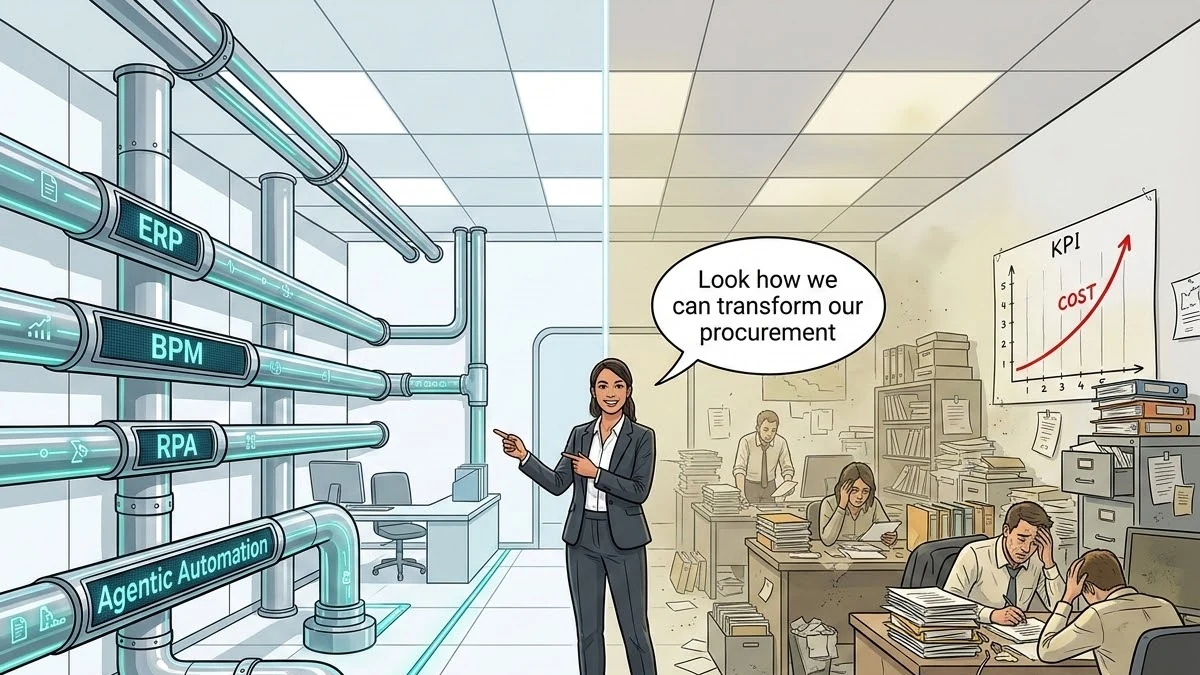
Why automating 70% of your P2P workflow doesn't transform your procurement.
The number is probably about right. That is what makes it dangerous. Because while the 70% can really be automated, it is the 30% that really moves the needle. According to Kovant research, if we plot the P2P transactions by the process variant or resolution pattern they follow, only approx 70% of the transactions match the standard process definitions in the ERP. These transactions have defined processes in the ERP with clear rules and workflows. The remaining 30% is the long-tail of ad-hoc transactions that land outside the standard process definitions and have no pre-defined rule or workflow. They land as manual work-arounds or exceptions for people to resolve — usually in ad-hoc tools like excel, email, docs and chat. And based on our research, these 30% of transactions cost 10-20X more in processing cost per transaction compared to the standard processes executed in ERPs.
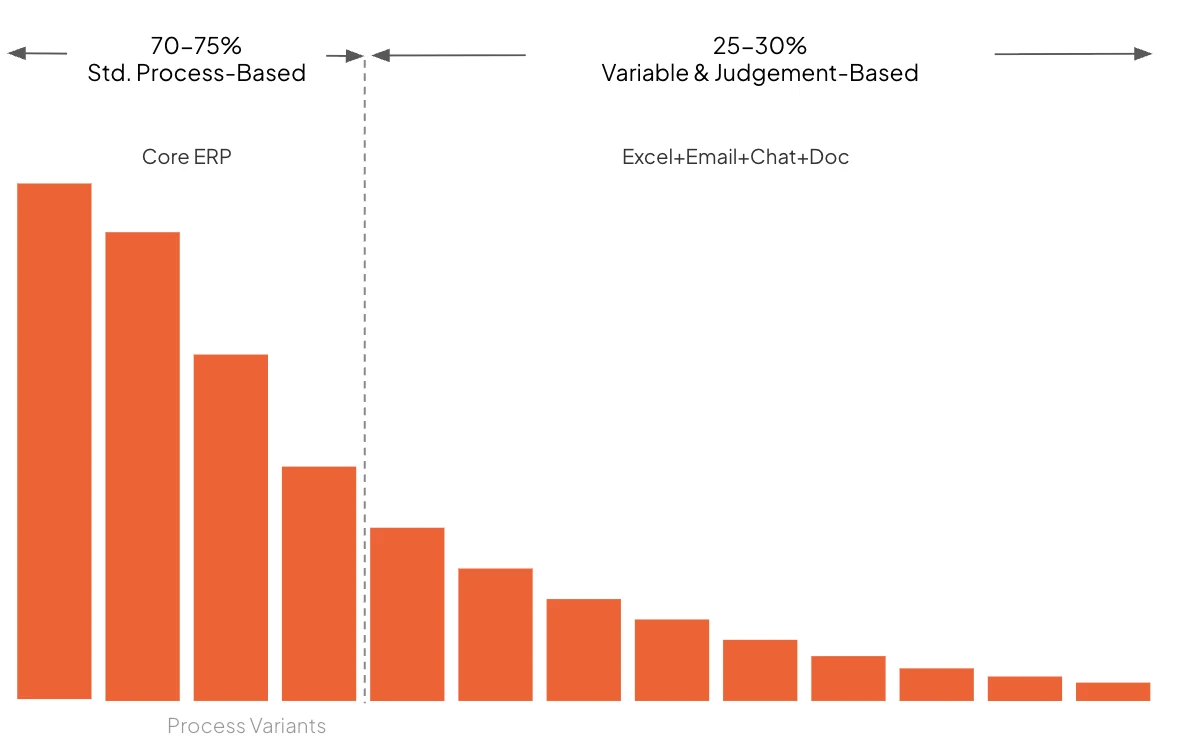
This creates a complex paradox for CPOs — while most automation tools (incl. Agents) automate the standard processes, the net benefit gained in terms of efficiency or productivity is less than 10-15%. All the while, the remaining 30% of the long-tail keeps draining the team bandwidth and productivity. This raises a very serious question on the strategic intent behind agentic implementations.
To Agent or Not to Agent — that is the question
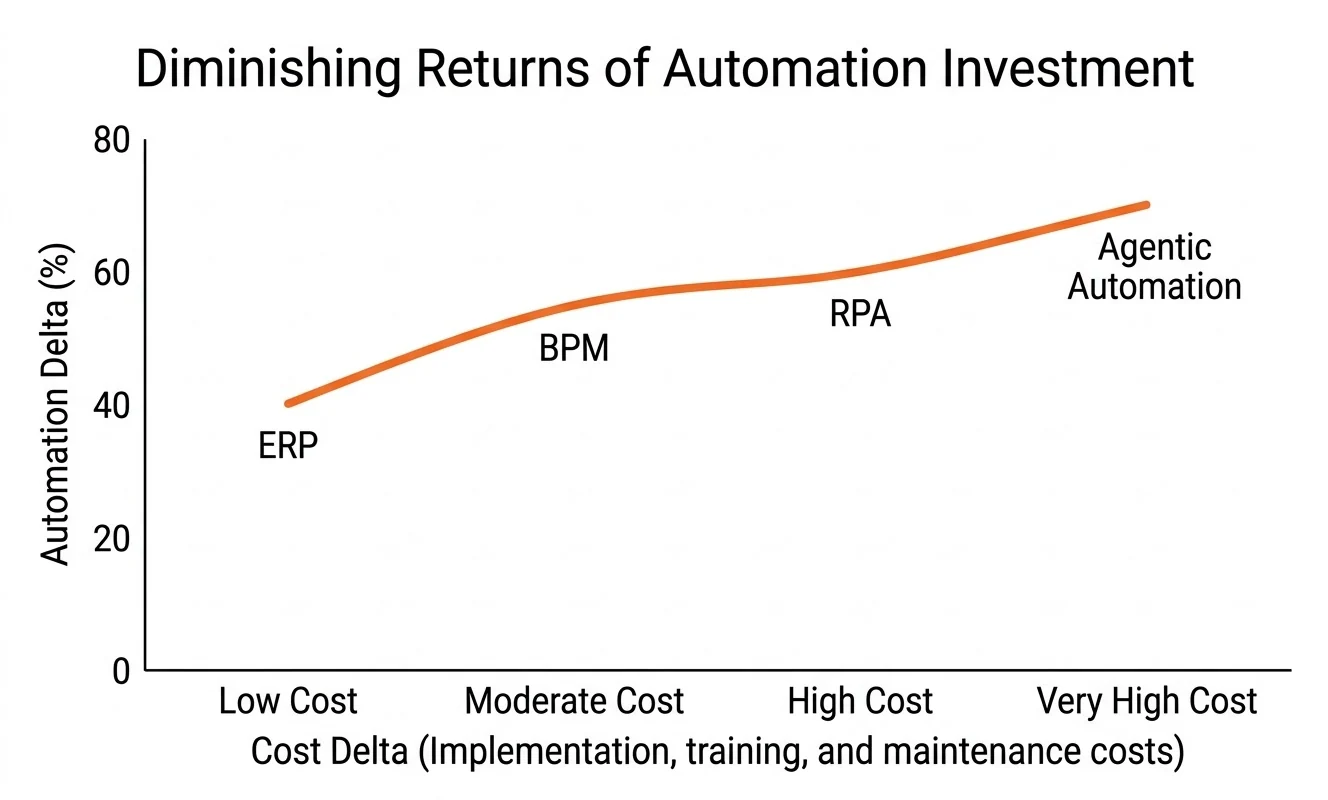
Automation is not a new strategic priority. The degree of automation possible has always been limited by implementation and technology capabilities. Agents are another engine to drive the automation directive after IPA, RPA, BPM, ERO and several others. Each technology layer added to the process-based architecture requires new investments, added maintenance costs, learning curve and we should evaluate the ROI of any new automation technology against this backdrop. The question is not whether technology can bring automation, the question is what is the Automation Delta (added efficiency or time reduction) against the Cost Delta (added implementation, training and maintenance costs). If we try to plot these 2 against the promised 70%, we see a diminishing return on investment.
Old Wine in New Bottle
Every automation runs the same, stale playbook — Analyze the processes, create new templates, define a new set of rules that were not previously considered, automate the transactional tier, redeploy a few heads, report the cycle-time gains at the QBR. This playbook gives you the same 70% coverage with a few percentage points higher efficiency.
And the remaining 30% remains as judgment work — strategic sourcing, complex negotiation, supplier relationships, new category strategy — which is exactly the list Rasulev names as the non-automatable remainder. Eighteen months later you have a marginally faster procurement function and the same margin you started with.
The category has hardened around the easy half
This is no longer one contributor's opinion. Gartner Peer Insights now maintains a standing market category for Procurement Orchestration Platforms, which means buyers are being routed into it by default. What is not being questioned, and what becomes the blind spot for CPOs, is the underlying Procurement Architecture. Tools that automated the processes without considering the underlying strategic shifts — spend consolidation, multi-sourcing, supply risk management, vendor rationalization — are automating what's left of the old procurement world, not the new sourcing challenges.
The transactional 60–70% is undifferentiated by definition. It is the work that looks identical no matter which customer, region or channel sits at the other end of it. That is precisely why it was never where your margin lived.
Your margin lives in the differentiated 30%: the rules about which categories need cost reductions, which need new supplier contracts or negotiated prices. Where is there an opportunity for a volume consolidation and where we need to diversify to mitigate supply disruptions. Automating the sameness is a speed project. Governing the difference is a margin project.
The efficiency squeeze is real, which is why the framing sells
The Hackett Group's 2026 Procurement Agenda and Key Issues Study projects procurement workloads rising 8% in 2026 while headcount and operating budgets decline. In Hackett's March 2026 release, 80% of procurement executives named AI the most transformational trend of the next five years, 43% were actively pursuing deployment — nearly double the prior year — and only 12% reported large-scale implementation. CPOs are looking for ways to cut the delays and processing costs in an effort to reduce total costs without impacting the supply. That squeeze is what makes "automate 60–70%" an easy yes.
The uncomfortable truth
The mental calculation that fuels these decisions is a linear volume-to-cost assumption. If we automate 70% of the procurement process, we can reduce the 70% cost right?
Wrong.
The costs are never evenly distributed. The 70% of transactions that run within your process already cost 10-20X less than the remaining 30%. This means on an average, the cost base for the 70% high-volume transactions is around 20% of the total cost base.
The 70% high-volume transactions contribute to only 20% of the total cost base.
The 30% of the long-tail operations that contribute 80% of your cost base is the highly variable, judgement and compliance heavy manual work. This is what is left 'Out-of-scope' by your vendors from the 'Phase 1' of your implementation roadmap that is often forgotten and silently pushed into archive.
Meanwhile, the people continue to bear the brunt of this workload in addition to learning the new tools. In most organisations these unsaid rules exist in someone's head, in an email thread, or in a pricing exception a regional manager grants because the customer called. They have never been written down in a form a system could apply, which is why they get applied inconsistently and why nobody can audit them. Many of these leave with the people, to be re-discovered and re-applied from scratch. The organization never learns how to handle them.
"Judgment work" is often just undocumented policy
Here is where the category's non-automatable list deserves a harder look. Some of it genuinely is judgment: a first negotiation with a sole-source supplier during a shortage, a decision to enter a new category, a call on a nine-figure commitment. Nobody would hand those to an agent in the first go.
But a large share of what gets filed under judgment is not judgment at all. It is a rule that was never articulated. When a category manager decides which of two suppliers takes an urgent order, they are usually applying a consistent policy — weighted by segment criticality, contract terms and current supplier performance — that has simply never been made explicit. Call it judgment and it stays manual, inconsistent and invisible forever. Write it down as policy and it becomes something you can run, measure, and change deliberately when the cost floor moves.
That is the actual test for an agentic procurement roadmap. Not what percentage of transactions it absorbs, but whether it can hold and enforce different policy for different segments, and show you what each one cost.
When should you start considering the 30%?
When we enter an agentic procurement initiative, we always start with the 30% where the real value is. That is the first scope we consider because even a 50% improvement in this category can deliver a 20-30% reduction in the cost AND add additional capabilities for the organization.
If you are evaluating autonomous procurement this quarter, this should be the first and central question to all the vendors — along with three changes to how you run the process:
- Change the demo. Stop asking vendors to raise a PO. Ask them to run the same request twice under two different scenarios and show you why the outputs differ. Most will show you the same output twice.
- Inventory your undocumented rules before you buy. Pick your top three margin-leaking categories and ask the people who run them to write down the rules they actually apply. The gap between what they write and what your systems enforce is your real automation backlog.
- Change the metric you report. Cycle time and touchless PO rate measure the undifferentiated tier. Add cost-to-serve variance by segment. If the automation is doing margin work rather than speed work, that number moves.
If you want to see what your own differentiated 30% looks like written as policy rather than as habit, that is a conversation worth an hour.
Sources
- Denis Rasulev, "Why 2026 Is the Year of AI Agents for Autonomous Procurement," SupplyChainBrain, 7 April 2026 — link (trade blog / category messaging — secondary)
- The Hackett Group, "2026 Procurement Key Issues," 25 February 2026 — link
- The Hackett Group, "The Hackett Group Reports Rapid Progress in Procurement's AI Agenda," 17 March 2026 — link
- Gartner Peer Insights, "Procurement Orchestration Platforms" market category, accessed 18 August 2026 — link
- Zip, "Zip Named a Visionary in the 2026 Gartner Magic Quadrant for Source-to-Pay Suites," BusinessWire, 23 January 2026 — link (vendor press release — vendor claim)
- Jason Snyder, "MIT Finds 95% Of GenAI Pilots Fail Because Companies Avoid Friction," Forbes, 26 August 2025 — link (secondary reporting on the MIT NANDA "GenAI Divide" report)