Why Enterprise AI Agents Stall, and How Neurosymbolic AI Can Get Them Moving

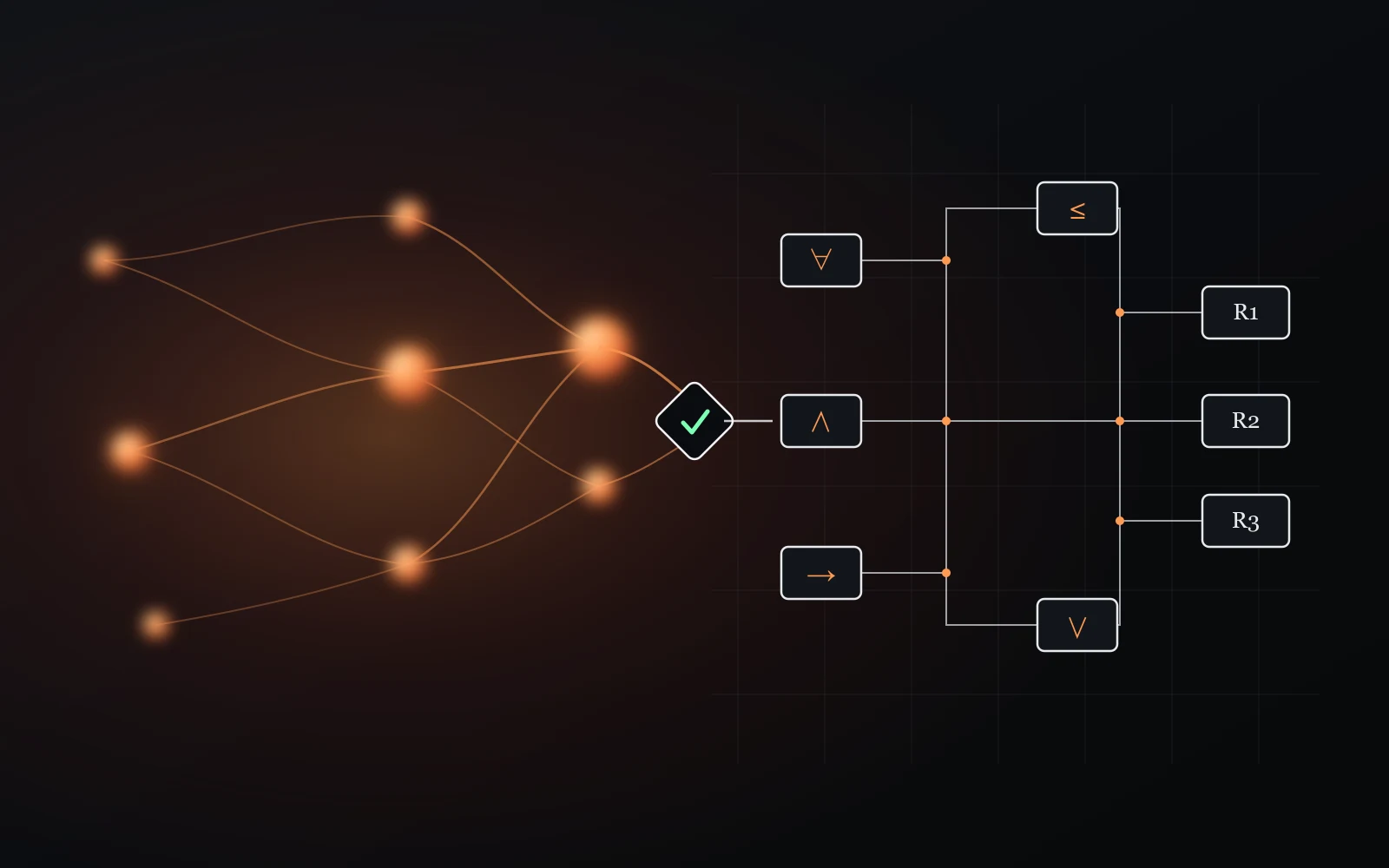
- AI agent pilots don't stall because the agent can't do the work. They stall because a probabilistic model can't guarantee it will stay within the rules, so a human ends up checking every action and the efficiency gain evaporates.
- The fix is not a smarter model. It is neurosymbolic architecture: a deterministic symbolic layer that validates every action the agent proposes against your rules before it can execute.
- Hard constraints, such as spending limits, approval thresholds, and compliance rules, become genuinely unbreakable, and every decision leaves an auditable trail a compliance team can sign off on.
- The payoff is agents you can trust to run unsupervised, which is the difference between a permanent pilot and a production system.
Every enterprise that has run an AI agent pilot in the last two years knows the pattern. In the demo, the agent is dazzling: it reads the request, reasons through the steps, drafts the document, and hands back something that looks production-ready. Then the project meets the real organization, with its audit requirements, spending limits, regulatory obligations, and the simple expectation that the same input always produces the same safe output. At that point the agent quietly stalls in a permanent pilot, with a human reviewing every action it takes.
The bottleneck is rarely capability. It is reliability. Large language models are probabilistic by design: they generate the most plausible next step, not the provably correct one. That makes them remarkably good at handling ambiguity and remarkably bad at offering guarantees. An agent that is right ninety percent of the time is a breakthrough in a research benchmark and a liability in an underwriting workflow, a purchase-order approval, or a patient-facing process. The failure modes that barely register in a demo, such as a hallucinated policy term, a quietly exceeded approval threshold, or a confidently wrong figure, become compliance incidents, financial exposure, and broken trust the moment real money and real obligations are on the line.
This is the central tension of enterprise automation. The whole point of an agent is autonomy: letting it act without a human in the loop for every step. But autonomy is exactly what an organization cannot safely grant to a system that has no hard limits on what it is allowed to do. So pilots default to the safest possible posture, in which a human checks everything, and that erases the efficiency gain that justified the project in the first place. The agent can do the work, but no one can trust it to do the work unsupervised, and so it never really gets deployed.
What neurosymbolic AI actually is
Neurosymbolic AI is a response to this tension, and it starts from a simple observation: the two great traditions of artificial intelligence are strong in precisely the places the other is weak.
The first tradition is neural: deep learning and the large language models built on it. Neural systems learn from data, recognize patterns, handle messy and unstructured inputs, and produce fluent, flexible, context-aware responses. What they cannot do is explain their reasoning in a way you can verify, guarantee they will follow a rule, or promise they will never take a particular action. They are powerful but fuzzy.
The second tradition is symbolic: the older world of explicit rules, formal logic, knowledge graphs, and reasoning engines. Symbolic systems encode knowledge that a human can read, reason deterministically (the same inputs always yield the same outputs), produce decisions that can be inspected and audited, and enforce constraints absolutely. What they cannot do is cope gracefully with the ambiguity, noise, and sheer variety of the real world; hand-written rules are brittle and do not scale to every situation a business encounters. They are rigorous but rigid.
Neurosymbolic AI combines the two into a single system, so the neural component does what it does best, interpreting intent, reasoning over unstructured information, and adapting to novel situations, while the symbolic component does what it does best: representing the rules explicitly, enforcing them deterministically, and making the system's behavior verifiable and explainable. Rather than asking one paradigm to compensate for its own weaknesses, neurosymbolic systems let each cover for the other.
A quick map of the territory: the six types of neurosymbolic AI
Neurosymbolic AI is not a single technique but a spectrum of architectures, distinguished by how tightly the neural and symbolic parts are bound together. The most widely used map of that spectrum comes from Henry Kautz, who laid out six categories in his 2020 AAAI address, "The Third AI Summer." They run from loose arrangements, where two separate systems pass messages back and forth, to deep fusions where logic lives inside the neural network itself. That progression captures a genuine trade-off: the more tightly you integrate the two, the easier the system is to train end to end, but the harder its reasoning becomes to inspect and guarantee.
In Kautz's framing:
- Type 1 (Symbolic → Neuro → Symbolic). Symbols go in, a neural network processes them, symbols come out. This is ordinary deep learning, and it describes essentially every large language model: text in, text out, with vectors in between.
- Type 2 (Symbolic[Neuro]). A symbolic system runs the show and calls a neural network as a subroutine for the parts it is bad at, such as perception or pattern recognition. DeepMind's AlphaGo is the classic example: a symbolic search procedure that leans on neural networks to evaluate board positions.
- Type 3 (Neuro; Symbolic). Neural and symbolic components work as co-equal partners, each handling the task it is suited to and passing results to the other. DeepMind's AlphaGeometry and AlphaProof work this way: a language model proposes ideas, such as a useful geometric construction or the next move in a proof, while a separate symbolic engine verifies and extends them, the two looping back and forth until a result holds. A simpler version of the same pattern is a neural network interpreting an image or a sentence while a symbolic engine reasons over what it found.
- Type 4 (Neuro: Symbolic → Neuro). Symbolic knowledge, meaning rules and logical relationships, is compiled into the neural network, effectively used to teach or structure it before or during training.
- Type 5 (Neuro_Symbolic). Logical constraints are embedded directly inside the neural network's machinery, so the rules shape what the network learns. Logic Tensor Networks are a representative example.
- Type 6 (Neuro[Symbolic]). The most ambitious and least mature: a genuine symbolic reasoning engine embedded inside a neural system, so the network itself carries out the kind of step-by-step combinatorial reasoning today's models struggle with. This one remains largely aspirational. Few if any systems convincingly achieve it, which is a large part of why reliable machine reasoning is still treated as an open frontier rather than a solved problem.
For enterprise purposes, the most useful thing this map reveals is where guarantees come from. The tightly fused architectures at the far end (Types 5 and 6) are powerful and learnable, but their reasoning is woven into the network and is correspondingly hard to audit. The looser, more modular arrangements (Types 2 and 3) keep the symbolic component separate and explicit, which is exactly what lets an organization read the rules, verify them, and trust they will be enforced. That distinction, often described more simply as integrative versus hybrid approaches, turns out to be the crux of why a particular class of neurosymbolic system is so well suited to running agents in production.
Why this is the missing piece for enterprise agents
The reason this matters for enterprise deployment is that it directly addresses the reliability gap that keeps agents stuck in pilots.
In a neurosymbolic architecture, the rules an enterprise cares about, such as spending limits, approval thresholds, segregation of duties, and regulatory constraints, do not live inside the language model, where they are merely suggested and can be ignored or hallucinated away. They live in a separate symbolic layer that sits outside the agent and is enforced deterministically. The neural agent proposes and reasons; the symbolic layer checks every proposed action against the rules and blocks anything that would violate them. That guarantee holds only as far as the mediation is complete: every channel through which the agent can actually act, every tool call, API, and side effect, has to pass through the validation layer, since any unmediated path is a way around it. Where that condition is met, the model cannot talk its way past a limit it is structurally incapable of overriding.
That single shift changes what an enterprise can responsibly delegate. Hard constraints become genuinely hard, so an agent can be granted autonomy for the bulk of its work while the symbolic layer guarantees it stays within bounds. Every decision carries an inspectable trail of which rules applied and why, which turns an opaque black box into something an auditor and a compliance team can actually sign off on. And grounding the agent's reasoning in explicit, structured knowledge reduces the hallucinations that make unconstrained models so risky in the first place.
This is a different way of thinking about reliability, and it is worth being precise about what it promises. A symbolic guardrail layer does not make the agent correct. It makes the agent's correctness beside the point. The model is never trusted by default; every action it proposes is checked against the rules before it is allowed to execute. This is the same principle that reshaped enterprise security over the last decade. A zero-trust architecture refuses to trust any actor simply because of where it sits in the network, and instead authenticates and authorizes every single request. Here the neural agent is the untrusted actor, and the symbolic layer is the gatekeeper that validates each move it tries to make.
Handled correctly, this sharply raises the ceiling on what can be safely automated, because it relocates the reliability problem to where it is more solvable. You cannot train a probabilistic model into a hard guarantee, but you can validate its outputs against an explicit, inspectable, testable set of rules. It would be dishonest, though, to pretend this comes for free. The guarantee is only ever as strong as the policies behind it, and authoring them is real, skilled work: someone has to translate how the business actually runs into rules complete enough to cover what matters, correct enough not to block legitimate work, and kept current as the business changes. This is the knowledge-acquisition problem that constrained the expert systems of earlier decades, and it has not disappeared. The bet a neurosymbolic approach makes is not that this work is easy, but that it is the better problem to own: a finite, visible rule set a team can test, audit, and improve beats an opaque model whose failures are unpredictable and unfixable, provided the organization is willing to invest in the rules as seriously as it would in the model.
In other words, neurosymbolic AI does not make an agent trustworthy by making it smarter. It makes an agent deployable by making its every move verifiable, moving the enterprise from "impressive in a demo, but someone has to watch it" to "trusted to operate on its own, because nothing it does reaches the real world without being validated first." That is the difference between a pilot and a production system, and it is why the enterprises serious about agentic automation are increasingly looking past the model alone to the architecture around it.
Further reading
For readers who want to go deeper, the sources below cover the map of neurosymbolic architectures referenced above, the landmark systems that put them to work, and the broader arguments for and against this approach.
- Henry Kautz, "The Third AI Summer" (AI Magazine, 2022) — the AAAI address that introduced the six-category taxonomy of neurosymbolic systems used above.
- Artur d'Avila Garcez and Luis Lamb, "Neurosymbolic AI: The 3rd Wave" (2020) — a survey framing neurosymbolic integration as the next phase of AI.
- Gary Marcus and Ernest Davis, Rebooting AI: Building Artificial Intelligence We Can Trust (Pantheon, 2019) — the case for combining learning with explicit knowledge and reasoning.
- Trieu Trinh et al., "Solving olympiad geometry without human demonstrations" (Nature, 2024) — the AlphaGeometry paper, a working Type 3 neural-plus-symbolic system.
- David Silver et al., "Mastering the game of Go with deep neural networks and tree search" (Nature, 2016) — AlphaGo, the canonical Type 2 example of symbolic search calling neural evaluation.
- Samy Badreddine et al., "Logic Tensor Networks" (Artificial Intelligence, 2022) — embedding logical constraints directly inside neural learning.
- NIST, "Zero Trust Architecture" (SP 800-207, 2020) — the security model whose "never trust, always verify" principle mirrors the symbolic guardrail approach.