Your value creation plan is a description of an operating model. It isn't one.


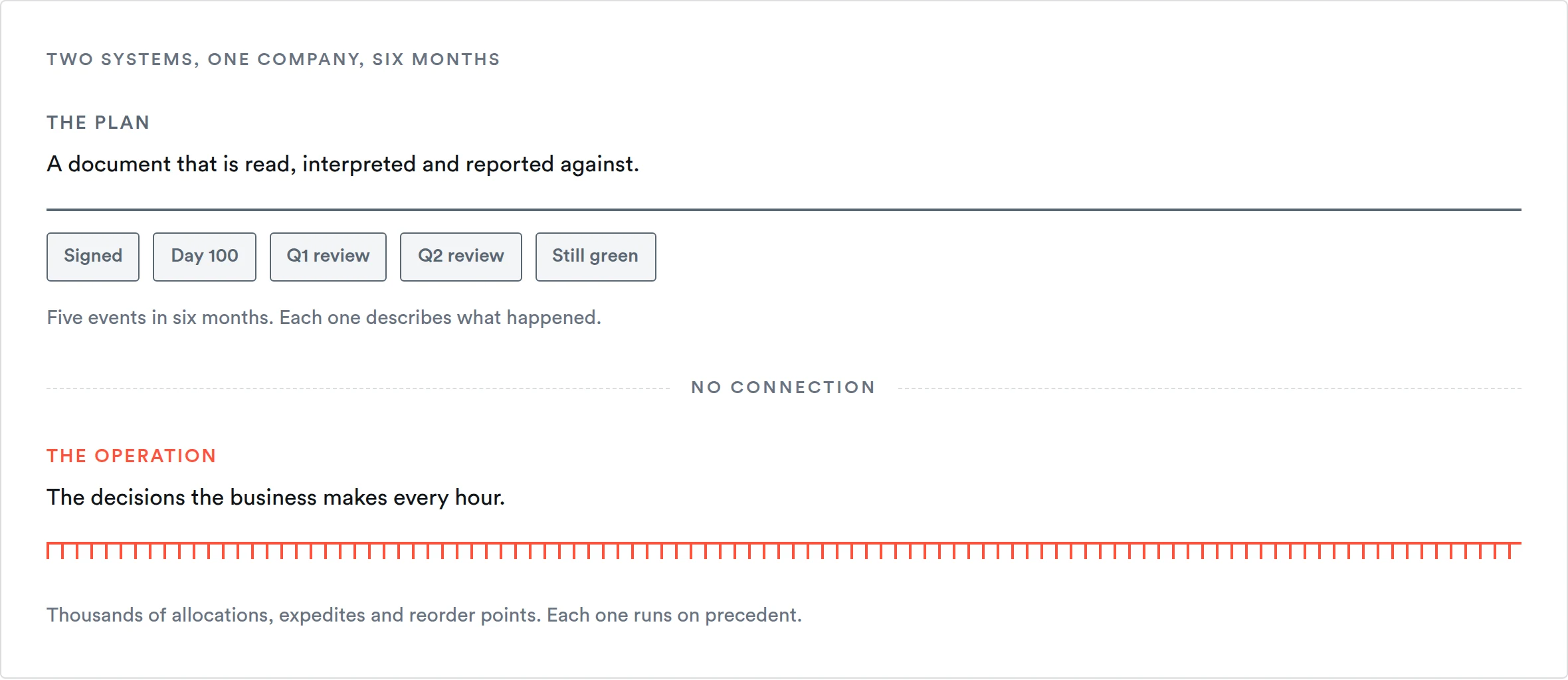
The plan is signed. The operating partner is seated, the first hundred days are mapped, and every workstream has an owner and a standing Tuesday slot.
Six months later the deck is current and the operation is not. The next order ships the way last year's shipped. The same three customers get expedited for the same undocumented reasons. Nobody has done anything wrong — the committee met, the slides were accurate, the owners reported status.
That gap is not an effort problem and it is not a talent problem. It is structural.
The plan and the operation are two separate systems that never touch. One is a document that people read, interpret and report against. The other is the set of decisions the business makes every hour: how this order gets allocated, which customer gets the expedite, what the reorder point is on this SKU in this segment.
A strategy in a memo is a description of an operating model, not an operating model. Transformation starts when the strategy — derived from this company's own data — becomes the operating policy the business actually executes.
Private equity has committed to the operations thesis without reservation
Bain puts buyout holding periods at exit “at around seven years — up from an average of five to six years from 2010 to 2021.” Behind those holds sit 32,000 unsold companies worth $3.8 trillion. Multiple expansion is not coming to rescue any of them. Bain's “12 is the new 5” framing puts the EBITDA growth now required at roughly 10–12% a year, against about 5% in the prior decade.
The GP population agrees. In S&P Global Market Intelligence's 2026 Private Equity Survey, 72% rank operational improvements as the top value-creation lever, and 60% say higher capital costs are forcing greater focus on portfolio-company operational performance.

So the thesis is settled. The open question is what firms do with it — and the standard answer is to hire.
Assume the hire is right. Assume the strategy is right too.
The familiar critique of the operating-partner model is that it pattern-matches: the credential is a track record somewhere else, so what gets bought is a playbook from another company.
“A real operating partner is not a hire you can mint on demand. The credential is a track record of having actually run a post-close transformation, and that pool grows slowly.”
Set that critique aside. Hiring on track record is not the error — it is the only sane way to hire. There is no way to assess whether someone can run a post-close transformation except by whether they have run one. Every firm in every industry hires this way, and it is right.
So grant both premises, generously. Grant that the operator is genuinely excellent. Grant, too, that the strategy they write is genuinely derived from this company's own data — its real cost-to-serve by segment, its own service failures, its own exception history — and not transposed from anywhere. The right person, holding the right answer.
It still does not execute. That is the part worth understanding, because it is the part that no amount of hiring, and no amount of further analysis, fixes.
And the right answer is always a differentiated one. Two industrial operators of the same size can have inverted profit distributions. One loses money on its largest account through order fragmentation and returns. The other loses it on a long tail of small customers, each consuming a service level designed for somebody else. The remedies are opposites.
That this distribution is steep and non-obvious is well established. In a documented case study of a professional-cleaning-products distributor, the top 20% of customers accounted for 95% of gross profit once indirect costs were properly traced — a picture invisible in the reported margin.
Which means the correct strategy is never “do this better”. It is “do this differently for these customers, in these regions, through these channels”. Hold that thought, because differentiation is precisely what the operation cannot carry.
The new strategy has to run on the old tracks
Take the plan at its word: differentiate service by segment.
That sentence has to become a decision. This order, from this customer, in this segment, gets this promise — and the next one gets a different one. A few thousand times a week, by people who will never read the plan.
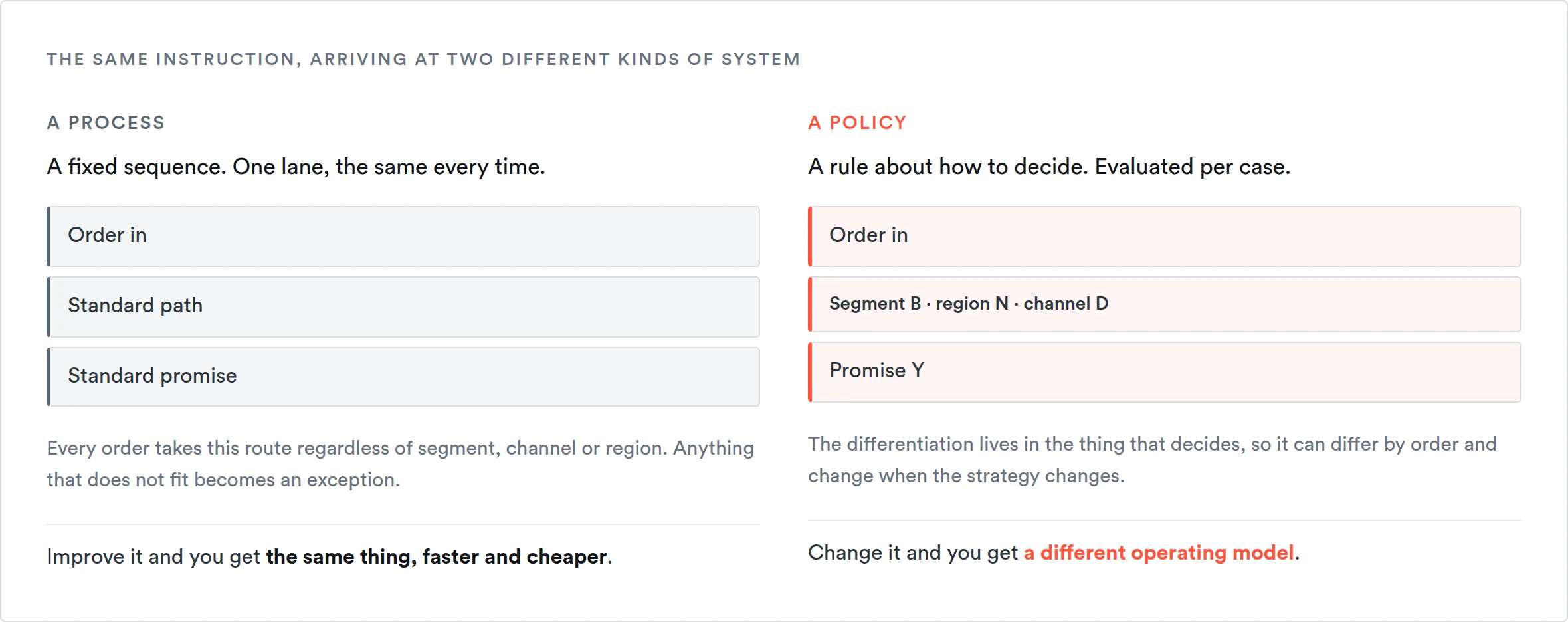
The processes that have to carry those decisions were built to do one thing the same way every time. That is what a process is: a fixed sequence, one lane, and an exception queue for everything that does not fit. It was designed, correctly, for the strategy that preceded this one.
So a differentiated policy arrives at a track with one lane.
What happens next is not misunderstanding. It is incompatibility. The strategy is perfectly well understood and simply unrunnable, so it gets approximated: a rule of thumb here, a manual override there, and — reliably — a spreadsheet somebody maintains privately, because it is the only place the real segmentation can live.
Improving the process is not the same as enabling the strategy
The VCI Institute's post-mortem on hundred-day plans catalogues what this looks like from the outside. Plans arrive carrying “forty or fifty workstreams” where five to seven would be executable. Governance follows: “a reporting cadence asks what happened. An operating cadence asks what we are going to do about what happened.” Then the owners drift — handed a workstream but not the authority, they operate as “project managers rather than decision makers”.
Each of these gets treated as a discipline failure. Trim the workstreams. Sharpen the meeting. Give the owners teeth. Sensible, and all three are downstream of the same thing: the strategy has nowhere to run, so the only work available is reporting on it.
The instinct at this point is to fix the processes. Map them, lean them, automate them. That work is real and it pays. It just pays in a different currency. A better process is faster, cheaper and more reliable at what it already does.
Efficiency answers are we doing this well? Strategy answers should we be doing this at all — for this customer, in this region, this quarter? No quantity of the first ever produces the second. You can automate your way to a very efficient version of the operating model you are trying to leave, and report the savings honestly while the strategy sits unexecuted.
Improving a process makes it better at what it already does. It does not make it capable of something else.
What the plan is missing is somewhere to run
Strategy says what should happen. People decide what matters and carry the authority to commit it. Neither of them executes. Execution is millions of micro-decisions, and something has to make them — every order, every allocation, every exception, for the rest of the hold.
For a differentiated strategy to execute, the thing making those decisions has to be able to hold the strategy itself — segment, channel, region, and a different rule for each combination — and to change when the strategy changes. That is a different kind of system from a process engine. Not a faster track. Something whose input is a policy.
Two properties do the work:
- Policies, not processes. The unit of control is a rule about how to decide, not a fixed sequence to follow. Differentiation stops being an exception and becomes the normal case, applied across the systems the operation already runs on rather than bolted beside them.
- A moving target, not a static KPI. The goal is a transformation the business is moving toward and keeps learning about — not a number signed off in month one and defended for seven years. A static KPI can only be reported against. A dynamic goal can be steered toward.
What a hundred-day plan should actually buy
Four things to change in the plan you already have.
- Split the efficiency programme from the strategy programme, on day one. They are different work with different deliverables and different evidence of success. Run together, the efficiency work takes credit for a transformation that has not happened — and because it is the more measurable of the two, it wins the steering committee every time. Give them separate owners and separate scorecards.
- Treat the private spreadsheet as the specification. Find it in week one. It is the most accurate statement of the real operating model anywhere in the company, and the person maintaining it has already written your policy engine by hand. Do not eliminate it as shadow IT. Read it, then build what it is compensating for.
- Put the policy where the decision happens. Not in the plan, not in a training deck, not on a dashboard. In the thing that allocates the order and sets the promise. If the strategy cannot be expressed there, it is not a strategy the business can run — and that is a platform requirement, not a change-management problem.
- Fund the operating platform, not the reporting layer. A reporting layer tells you the strategy is not landing. You already know that by month four. The spend that changes the outcome is on the substrate that executes policy — flexible enough to differentiate by segment, channel and region, and integrated enough to do it across the systems the operation already runs on.
A hundred-day plan that ends with an approved strategy and a governance cadence has bought a description of an operating model. A hundred-day plan that ends with the strategy running — as policy, in the thing that makes the decisions — has bought the operating model itself.
That is the whole difference. And it is a purchasing decision, not an insight.
Policy-based operations is what this looks like once it is built: the strategy is the executable artefact, and the operation runs it.
Sources
- Private equity resurgence gathers steam as new era challenges firms to enhance value creation — Bain & Company Global Private Equity Report 2026, 23 February 2026. Seven-year holds; 32,000 unsold companies worth $3.8tn; “12 is the new 5”.
- 2026 Private Equity Survey: fundraising confidence rising as managers pivot to operational value — S&P Global Market Intelligence, 13 April 2026, fielded February 2026. 72% rank operational improvements the top lever; 60% cite capital costs.
- The Operator Supply Gap: Why Private Equity Can't Staff Its Operations Pivot — Not Very Private Equity, 3 July 2026. Secondary commentary; the operating-partner credential quote.
- The 100-Day Autopsy: Why Most Value Creation Plans Stall by Day 90 — VCI Institute, 11 June 2026. Secondary commentary; forty-to-fifty workstreams, reporting versus operating cadence, “project managers rather than decision makers”.
- The implementation of customer profitability analysis: a case study — van Raaij, Vernooij & van Triest, Industrial Marketing Management, 2003. Peer-reviewed; top 20% of customers held 95% of gross profit. Cited as a structural finding, not current market data.